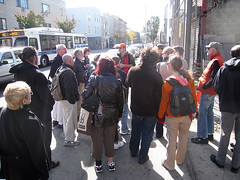
 Bushwick was graced with another walking tour from the good folks at bcue.org, and as usual I nearly missed it. I got all confused about the dates and realized it was happening this past Sunday with some 20 minutes to spare. I made it to the Myrtle-Wyckoff station a little late, but hey, the walking tour is pretty easy to pick out of a crowd.
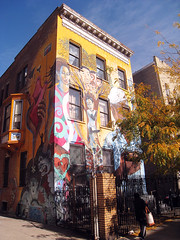 Apparently this tour was written up in Time Out: New York but I didn't catch the article (did anybody see it?) So besides the usual gaggle of old-timers and locals there were a few tourists. Though who can really tell these days.
This tour focused on Bushwick's most commonly-associated aspects, namely the blackout, the fires, the drugs, the mob influence, the crooked landlords, the specter of gentrification. Yet it was a lovely fall day and tour leader Adam Schwartz is great as an educator and raconteur, so he made sure it wasn't a total bummer. 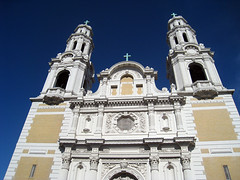 Some highlights included visiting St. Barbara's a Spanish Baroque style Catholic church built in 1909. Regardless your feelings on religion, you gotta admit this is a kick-ass building. You can't believe you're in Bushwick when you're inside it looking up at the insane level of detail on every available surface. Bushwick historian John Dereszewski was on hand and mentioned that he remembers an even stranger sight: St. Barbara's during Bushwick's nadir, pristine while surrounded by rubble and neglect.
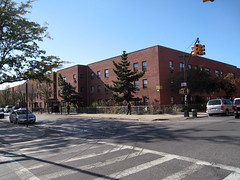
We also covered the Hope Gardens housing project, which may bore some, but I find fascinating. It was the last housing project created before Reagan ended the whole 'experiment,' but has proven to be the most successful. Instead of monstrous high-rise buildings, Hope Gardens is mostly 3-story buildings, some set up like apartment complexes and some more like townhouses, complete with garden apartments. You see Hope Gardens in many locations throughout the neighborhood; its sprawling footprint was determined largely by which blocks were most decimated by fire. It's sort of too bad they weren't able to reproduce this model elsewhere.
 The tour culminated with a stroll through Maria Hernandez Park (where people were playing volleyball, which kind of blew my mind until Adam explained its popularity in Ecuador and Mexico). We ended things at "The Well," a block of Knickerbocker that previously contained a seemingly-bottomless supply of drugs in the 80s. Say what you will about the neighborhood now, we're already a long way from that now.
Some photos from the tour are here.
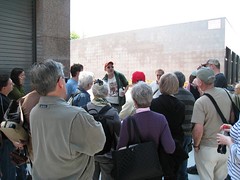 I went on the latest
  When I walk around my neighborhood, it's usually for some purpose like running errands or heading to the train. I don't get a lot of time to stroll around and just look at the place. Since I spend most of my time on Broadway, my view of Bushwick is loud and garbage-strewn, with a lot of shuttered storefronts. While this may be accurate, there's also a lot of charming homes and people hidden in there somewhere. It seems odd to have such a revelation since I've been living here for nearly two years; I realized that my estimation of the neighborhood has been,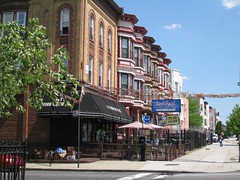
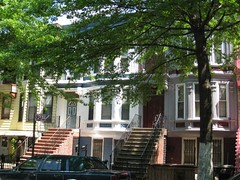
 I was a bit disappointed to see only a couple of people I recognized from the
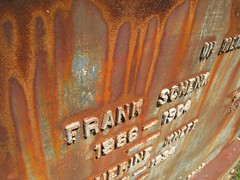
 We saw several sides of the neighborhood, the beautiful churches, the Shell station that used to be
 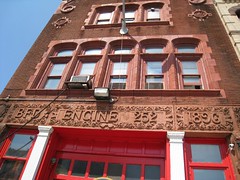 I had to ditch the tour a little early to go to a band rehearsal, but not before we saw an impeccably-appointed fire house, and spied a pigeon coop on top of a building on the corner of Eldert Street. Adam explained the sport of pigeon flying, in which competitors try to lure other people's pigeons (O.P.P.) into their flock. I knew about the sport after puzzling over the "
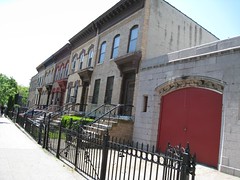 Ironically the tour ended up making things seem less exotic to me. Demystifying the neighborhood is a good thing since I feel like I understand a little more clearly how this spot I call home came to be. But knowing the history doesn't change the fact that it's still just a neighborhood, the changes that have occurred since I got here are just another drop in the bucket.


